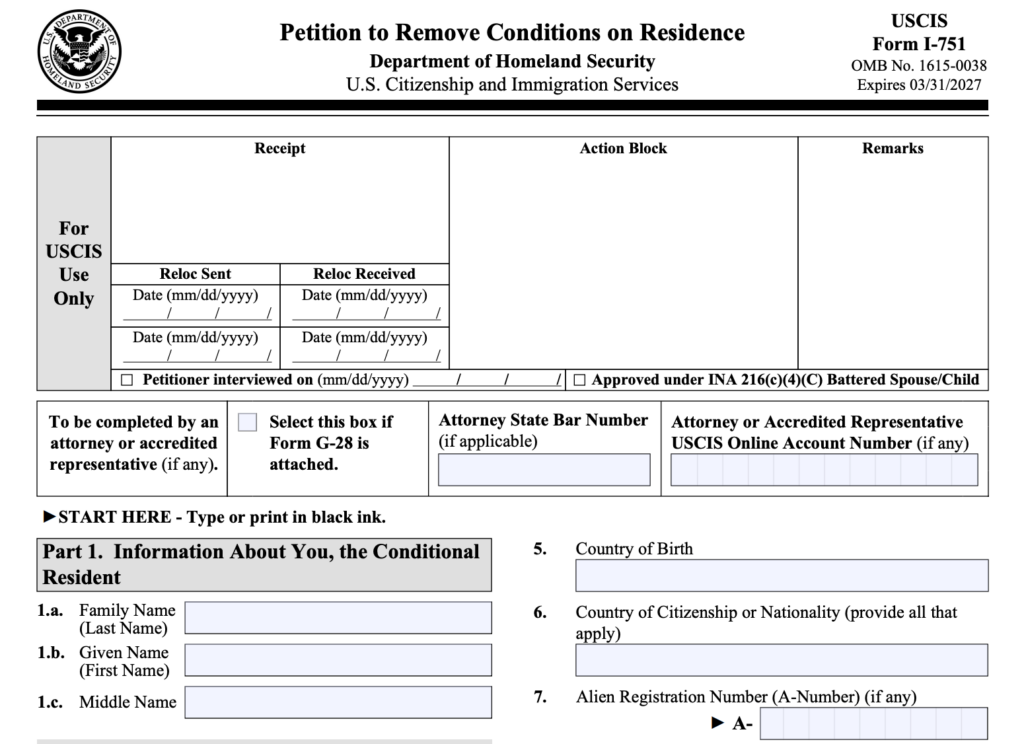
If you got your green card and had been married for less than two years when it was approved, you received a conditional green card, not a permanent one. Before that two-year card expires, you and your spouse have to file Form I-751.
Many people are surprised to learn that their conditional green card expires after two years. Others worry about what happens if they divorce, separate from their spouse, experience abuse, miss the filing deadline, or receive a denial notice. Missing the window, or getting the paperwork wrong, can put your permanent resident status at real risk.
This guide explains what you need to know about Form I-751, including the filing window, evidence, joint petitions, divorce, abuse waivers, hardship waivers, receipt notices, and what happens if USCIS denies your case.
Key Takeaways:
If your situation touches any of these issues, book a consultation before your window closes.
Table of Contents
Form I-751 is officially the Petition to Remove Conditions on Residence. It exists because USCIS issues a card valid for only two years, rather than a full ten-year card, when a marriage is less than two years old at the time of approval.
A conditional resident holds the same rights as any other green card holder. They can travel, work, and live anywhere in the country. What's missing is the security of long-term status, since the card has a fixed expiration date and doesn't renew automatically.
Conditional green card holders who miss that date lose more than paperwork; they lose lawful status. Filing the petition on time converts conditional residence to full permanent resident status; at that point, a conditional permanent resident simply becomes a permanent resident, full stop.
Your conditional residence expires two years after it was granted. You must file sometime in the 90 days right before that date, not earlier and not too long after.
You do not have to file on day one of that window. Filing around the 30-day mark still works for most people, but waiting past the deadline is risky. Once USCIS receives a timely petition, it issues a document that automatically extends your status for 24 or 48 months while the case is pending. This is called a receipt notice. Keep it with your permanent resident card and current passport when you travel or renew a driver's license.
If you miss the window entirely, your legal status ends on the expiration date printed on the card. USCIS can technically accept a late filing with a good explanation, but you should not count on that. Waiting too long is one of the most preventable causes of losing lawful permanent resident status.
If your card has already expired and you have never filed, talk to an immigration attorney immediately rather than waiting for USCIS to catch up with you.
The joint filing requirement is the default path. Both spouses sign the petition together, along with updated evidence that the marriage is ongoing. This isn't about resubmitting everything from your original green card case. It's about showing the relationship has continued since then.
Strong joint petitions typically include:
USCIS officers are looking for a consistent pattern, not a mountain of paper. A bona fide marriage is proven through ordinary life evidence, not volume. If you have kids together, that documentation alone carries significant weight, and any conditional permanent resident children who received their status around the same time as the primary applicant can usually be included in the same petition.
Divorce doesn't automatically end your immigration case, but it does change how you file. If your marriage collapses before the petition is submitted, you're no longer eligible for the standard joint route. Instead, you may qualify to request a waiver of the joint filing requirement by showing that you entered into the marriage in good faith.
Timing matters more here than almost anywhere else in this process. Some couples divorce while an I-751 is already pending. In that case, USCIS typically issues a request for additional evidence rather than an automatic denial, giving you a chance to convert the case to an individual filing with your divorce decree and evidence that the marriage was real while it lasted.
Waiting to finalize the divorce before you file, when your card is about to expire, is a mistake we often see. If your case is close to that deadline and your divorce is still moving through family court, get legal advice from Hacking Immigration Law, LLC before that deadline arrives rather than after.
Federal law allows someone with conditional permanent resident status to file the I-751 alone if the marriage involved domestic violence or extreme cruelty. This comes from the Violence Against Women Act, and despite the name, it applies regardless of the abused spouse's gender.
To qualify, you'll need to submit a waiver request with documentation such as police reports, protective orders, medical records, or a statement from a therapist or counselor. You do not need your abusive spouse's cooperation or signature to file this way, and you're not required to be still married to the petitioning spouse at the time you submit it.
What USCIS wants is credible evidence, not a perfect paper trail. If you're still living with the abusive spouse, expect the immigration officer to scrutinize the case more closely. Most attorneys advise separating from the household first whenever it's safe to do so.
Some couples file a joint petition while their marriage is still intact, only for things to fall apart during the long wait for a decision. This is more common now that processing has slowed. A case that used to take three or four months can now sit for well over a year, and that kind of delay puts real strain on a relationship.
If this happens to you, don't withdraw the petition and don't panic. Notify USCIS of the change in circumstances and be prepared to convert the filing to a divorce-based or abuse-based waiver if the marriage legally ends before a decision is made. The underlying evidence you already submitted showing the marriage was genuine at the time still matters, even if it isn't genuine anymore.
Processing time varies based on the level of scrutiny a given case receives or on the USCIS service center. Historically, processing has ranged from about 10 to 23 months, though average processing time for many applicants lands closer to 12 to 18 months.
That range is wide enough that it’s worth checking current data for your specific service center before making travel or renewal plans, and building in extra time when you can.
Most petitions are approved without an interview if the evidence is strong. USCIS has leaned more heavily on interviews in recent years, which is part of why timelines have stretched. If you do get an interview notice, treat it as routine rather than alarming; bring originals of everything you submitted, plus anything that has accumulated since filing.
The filing fee for Form I-751 is $750, which already includes the biometrics fee, so there's no separate charge for fingerprints and photos. If you're having more than five children on the same petition, an additional $85 applies for each child beyond the fifth. USCIS fees change periodically, so confirm the current amount on the USCIS website before you submit payment.
A fee waiver is available if you can document financial hardship, such as receipt of a means-tested public benefit or household income under 150% of the federal poverty guidelines. You can file the form and supporting evidence online or by mail, depending on your case.
Do I have to file an I-751 with my spouse?
Most applicants do file jointly. You can request an individual waiver if you're divorced, if your U.S. citizen or lawful permanent resident spouse died, or if the marriage involved abuse.
What if USCIS never sent me a reminder about my deadline?
Some offices ask you to sign an acknowledgment form at your original interview, but not all do. The deadline applies whether or not you were reminded, so track your card's expiration date yourself.
Can I still travel while my I-751 is pending?
Yes. That notice extends your status and serves as proof of lawful residence alongside your expired card for travel purposes.
What happens if I file late?
Filing after the 90-day window closes puts you at risk of losing status and facing removal proceedings. If you've already missed the deadline, get legal help from Hacking Immigration Law, LLC immediately rather than waiting.
Does getting divorced automatically end my case?
No. It changes your filing category from joint to a waiver based on a good-faith marriage, but a pending case doesn't have to be withdrawn just because the marriage ends.
Every one of these scenarios plays out differently depending on your specific timeline and evidence. Talk to our office before your two-year window runs out so we can build the strongest case for your specific situation.
Form I-751 is a deadline-driven filing, and immigration law doesn't leave much room for error once that 90-day window opens. Whether you're filing with a lawful permanent resident spouse or a U.S. citizen, requesting a waiver after divorce, or filing alone because of abuse, the evidence you gather and the timing of your submission decide the outcome more than anything else.
Permanent residents who get this filing right move on to a 10-year card and stop thinking about immigration paperwork for a decade. Those who miss the deadline or file a thin case without guidance end up facing a request for evidence or a denial that could have been avoided.
If your filing window is closing soon or your marital situation has changed since you received your green card, consider getting a case review from Hacking Immigration Law, LLC before filing, rather than waiting until USCIS sends you questions.