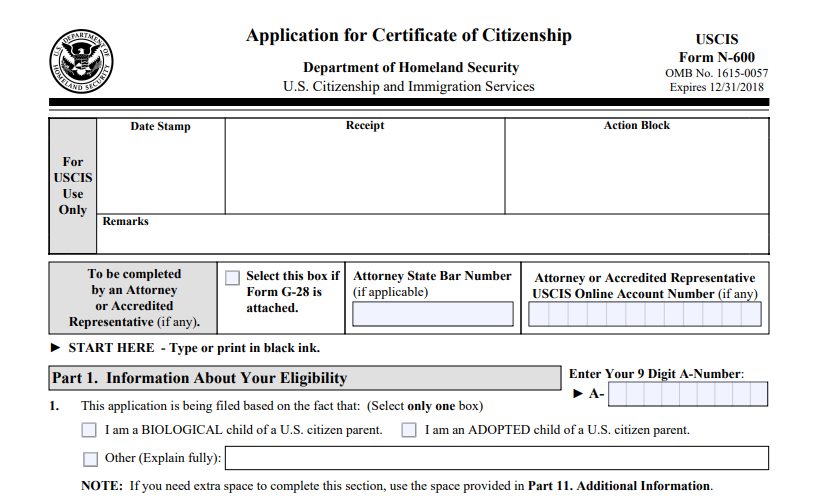
Form N-600 is the USCIS application used to request a Certificate of Citizenship. This certificate proves that you are already a U.S. citizen, either because you were born to a U.S. citizen parent or because you automatically became a citizen at birth through a parent who naturalized.
If you are applying for U.S. citizenship through Form N-600, you may be wondering how long it will take for your application to be processed.
The N-600 processing time can vary depending on many factors, including your local USCIS office, whether a biometrics appointment is required, and how complete your initial application is. Fortunately, there are ways to ensure your application is processed in a timely manner.
If you are not sure whether you need Form N-600, Form N-400, Form N-600K, or Form N-565, this guide walks through the differences, who qualifies, what evidence USCIS wants, how long N600 processing can take, and what to do if USCIS sends a Request for Evidence or denies the case.
Read on to learn about:
Save time and skip the guesswork of complex citizenship laws by working with an experienced immigration attorney.
Table of Contents
A Citizenship Certificate is an official USCIS document proving that you are a U.S. citizen. It can be used as evidence for certain rights and privileges—such as eligibility for a U.S. passport. It serves as legal proof that you became a U.S. citizen through derivation — not naturalization — and can be used to apply for a U.S. passport.
It can also be used in certain cases as evidence in court proceedings regarding immigration matters or other legal proceedings involving your status as a U.S. citizen.
Form N-600 is an application filed with the United States Citizenship and Immigration Services (USCIS). This application is used to apply for a Certificate of Citizenship.
You may need a Certificate of Citizenship if:
The main reason to file N600 is certainty. When USCIS approves the application, the Certificate of Citizenship becomes a permanent proof document that can be used for the rest of your life.
Speak with a qualified immigration lawyer to verify your eligibility and streamline the process.
A U.S. passport is not the same as a Certificate of Citizenship because the passport is issued by the U.S. Department of State, while the Certificate of Citizenship is issued by USCIS. USCIS is not always bound by what the State Department did when it issued the passport.
You may have received a U.S. passport because the State Department accepted your citizenship evidence at that time. But if a citizenship question comes up later with USCIS, the passport alone may not fully clean up the immigration record. USCIS may still want proof of how citizenship was acquired or derived.
The problem is especially common for children who became citizens through a parent. The child may have a passport, travel as a U.S. citizen, and live as a U.S. citizen, but USCIS may still have the person listed as a lawful permanent resident unless the family files Form N-600 and obtains the Certificate of Citizenship.
Some people are U.S. citizens from the moment they are born, even if they are born outside the United States. This is called the acquisition of citizenship at birth.
Citizenship acquired at birth abroad usually depends on:
Whether the U.S. citizen parent is the mother or father, different rules can apply in certain cases. This is where families often make mistakes. They assume that having one U.S. citizen parent automatically makes the child a U.S. citizen. That is not always true.
In many cases, the key issue is the U.S. citizen parent’s physical presence in the United States before the child’s birth. USCIS may want school records, tax records, employment records, leases, medical records, military records, or other proof showing that the parent met the required physical presence rule.
Important Note: Form N-600 can be used to request that USCIS issue a Certificate of Citizenship for a person born abroad who acquired citizenship at birth. The application should clearly explain the legal basis, the parent-child relationship, and the evidence of physical presence.
Derivative citizenship means a child automatically becomes a U.S. citizen at birth because a parent has naturalized. In many cases, this happens when the child is under 18, has a green card, and is living in the U.S. in the legal and physical custody of a U.S. citizen parent.
The child becomes a citizen by operation of law if the legal requirements are met. Form N-600 is then used to prove it.
A common derivative citizenship case looks like this:
When those requirements are met, the child may already be a U.S. citizen. But USCIS systems may still show the child as a green card holder until the family files Form N-600 and gets a Certificate of Citizenship.
Parents with green cards should not wait to naturalize if they have children who are also green card holders and under 18. If the parent becomes a U.S. citizen before the child turns 18, the child may automatically become a U.S. citizen too. This can be one of the biggest immigration benefits a parent gives a child.
Here is the issue. If the parent waits too long and the child turns 18 before the parent naturalizes, the child may lose the chance to automatically derive citizenship from that parent. The child may then need to file Form N-400 later, qualify for naturalization independently, pass the citizenship test, meet the residence requirements, and complete the full naturalization process. This is why timing matters so much.
Even if the child can obtain a U.S. passport after the parent naturalizes, the better long-term move is often to file Form N-600 as well. The Certificate of Citizenship helps prove the child’s status to USCIS and keeps the citizenship record clean.
Internationally adopted children may also need a Certificate of Citizenship. In some adoption cases, a child automatically becomes a U.S. citizen upon entering the United States as a lawful permanent resident and residing in the legal and physical custody of a U.S. citizen parent.
The rules for adopted children depend on the child’s visa category, the adoption process, custody, residence, and whether the adoption was final before the child entered the United States.
Evidence in an adopted child’s Form N-600 case may include:
International adoption cases can be approved, but USCIS expects the paperwork to match the statute. If the record is incomplete, USCIS may issue a Request for Evidence.

When filing Form N-600, you have two options:
The easiest way to file Form N-600 is through the USCIS website.
Create an online account on the website and fill out all sections of the application with as much detail as possible. You will also be required to upload digital copies of your supporting documents during this process. Once you have completed all sections, double-check everything before submitting.
Filing your Form N-600 online will allow you to:
Our immigration attorneys or any accredited representatives may create your online account, allowing us to manage our client’s application in a single place.
Note: You can’t file online if you are applying for a fee waiver or from outside the U.S. A veteran or member of any U.S. military branch filing on your own behalf can’t also file Form N-600 online. Please check how to file by mail.
If you can’t file online or prefer to submit a paper application form, you will need to file your Form N-600 through regular mail. Send your application with all necessary documents enclosed to the USCIS field office using the listed mailing address listed on their website. You may also need to submit additional forms depending on your circumstances.
Once your application has been submitted, you will receive a USCIS Account Acceptance Notice through the mail. This includes instructions for creating your online account to manage and track your case. Remember that even if you don’t create an online account, USCIS will process your application. They will also send you copies of notifications about your case by mail. But creating and accessing an online account is highly recommended.

The average N-600 processing time is 3 to 25.5 months (last verified October 2026), depending on your chosen USCIS Service Center. You can check your case processing time here – check your receipt notice to find your form, category, and the office processing your case.
In general, applications for citizenship through naturalization (Form N-400) tend to take longer than applications for certificates of citizenship (Form N-600).
What you pay for Form N-600 depends on how you file and whether you qualify for an exemption or waiver, as shown below.
| Fee detail | What applies |
| Filing online | $1,335 |
| Filing on paper or by mail | $1,385 |
| Savings from filing online | $50 |
| Fee exemption (qualifying current or former U.S. armed forces member filing for themselves, or certain adoption cases) | $0 |
| Approved fee waiver | $0 (request with Form I-912, Request for Fee Waiver) |
| Biometrics | May still be required, but there’s no separate biometrics fee |
| Children of service members | Don’t qualify for the armed forces exemption |
Last verified: October 2026; Source: Form G-1055, Fee Schedule
The fee for filing Form N-600 online is $1,335. (No filing fee if you are a member or veteran of the armed forces of the U.S., provided that you present proof of service.)
You can pay this fee with:
Note: If you choose to pay by check, make it payable to the U.S. Department of Homeland Security.
Once you send your payment, you agree to pay for the government service. The filing fee is non-refundable, regardless of any action USCIS takes on your application or if you withdraw it.
Immigration Answers - Join Live Shows
The documents needed for Form N-600 depend on how the applicant became a U.S. citizen. The evidence for citizenship at birth abroad is different from the evidence for derivative citizenship after a parent naturalizes.
Common Form N-600 evidence includes:
For acquired citizenship at birth abroad, the physical presence evidence is often the most important part of the case. USCIS may need to see exactly when the U.S. citizen parent lived in the United States before the child was born.
For derivative citizenship after naturalization, the parent’s naturalization date and the child’s age matter. The evidence should show that the child was under 18, had lawful permanent residence, and was living in the legal and physical custody of the U.S. citizen parent when the citizenship requirements were met.
While waiting on approval of your Form N-600, do not engage in any activity that could jeopardize or delay the approval of your application. These include committing a crime or traveling outside the United States without permission from USCIS.
Important Note: If anything changes regarding the information you provided on your application (for example, if you get married), inform USCIS right away. And provide them with supporting documentation. That way, they can update their records and adjust their processing time.
If USCIS issues a Request for Evidence, it means the officer needs additional documents before deciding on the N600 application. An RFE is not a denial, but a warning that the case has not yet been proven.
A Form N-600 RFE may ask for:
Your response should directly address the legal issue USCIS raised. If USCIS asks for five years of physical presence, the response should include a timeline and records that prove the dates.
If USCIS denies Form N-600, the denial should explain why USCIS believes the applicant did not prove citizenship. Depending on the case, the applicant may be able to file Form N-336 to request a hearing on the denial, file a new Form N-600 with stronger evidence, or pursue another legal strategy.
A denial is serious because citizenship claims can affect future immigration filings. If USCIS denies the Certificate of Citizenship, talk to an immigration lawyer before filing again.
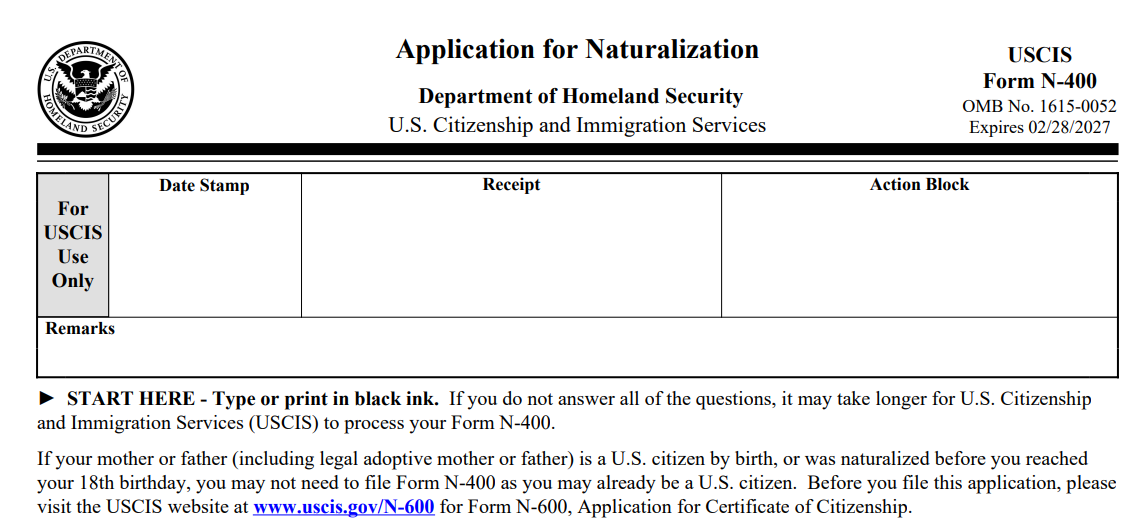
Form N-600, N-400, N-600K, and N-565 each serve distinct legal purposes and are not interchangeable. Here is how to choose the right form:
| Form | Who files it | What does it prove | Current fee | Current processing time |
| Form N-600 | A person who has already acquired or derived U.S. citizenship through a parent, or a parent or legal guardian filing for a child. | Requests a Certificate of Citizenship from USCIS. It proves the person is already a U.S. citizen. | General filing: $1,385 paper or by mail, $1,335 online. Some military and adoption-related categories may be $0. | Varies by USCIS location and case complexity. Many cases take months, and some take a year or longer. |
| Form N-400 | A lawful permanent resident applying to become a U.S. citizen through naturalization. | Starts the naturalization process. It does not prove existing citizenship. It asks USCIS to grant citizenship after eligibility, interview, testing, and oath. | General filing: $760 paper, $710 online. Reduced fee and military categories may apply. | Varies by USCIS field office. |
| Form N-600K | A U.S. citizen parent, or qualifying guardian, filing for a child who regularly resides outside the United States. | Requests citizenship and issuance of a certificate under INA section 322 for certain children living abroad. This is different from Form N-600 because the child may need to complete the process through USCIS before citizenship is issued. | General filing: $1,385 paper, $1,335 online. Certain adoption-related filings may be $0. | Varies by USCIS process and appointment scheduling. |
| Form N-565 | A person who already had a Certificate of Citizenship, Certificate of Naturalization, Declaration of Intention, or related document and needs a replacement or correction. | Replaces or corrects an existing citizenship or naturalization document. It does not create citizenship and does not prove a new citizenship claim. | General filing: $555 paper, $505 online. USCIS error correction may be $0. | Varies by USCIS workload. |
One real Certificate of Citizenship case involved a U.S. citizen mother whose child was born in Africa. The mother had left an abusive family situation and brought the child to the United States on a tourist visa. The question was whether the child was already a U.S. citizen.
Our immigration lawyers prepared Form N-600 and submitted evidence about the child’s birth and the mother’s citizenship. USCIS then issued a Request for Evidence asking for proof of how much time the U.S. citizen mother had spent in the United States before the child was born.
That was the key legal issue.
In that case, the law required proof that the mother had spent five years in the United States before the child’s birth, with at least two of those years after the mother turned 14. The mother was born in 1996, turned 14 in 2010, left the United States in 2013, and the baby was born in November 2014.
The RFE response had to do more than merely state that she had lived in the United States. It had to prove the timeline.
After a timeline and supporting documents were provided, the case was approved. The child was scheduled for the ceremony to obtain the Certificate of Citizenship.
This case shows how Form N-600 cases are won or lost. USCIS does not approve these applications just because the family believes the child is a citizen. USCIS wants the legal requirements documented with evidence.
A Certificate of Citizenship is legal proof that you are a U.S. citizen, while green cards grant lawful permanent resident status - not citizenship. Unlike green cards, a Certificate of Citizenship does not expire and confirms full citizenship rights, including the ability to apply for a U.S. passport.
Form N-600 is used to apply for a Certificate of Citizenship. It is for a person who is already a U.S. citizen through acquisition at birth abroad or through derivative citizenship by a parent, and who needs USCIS to issue formal proof.
Form N-600 does not make you a U.S. citizen. It asks USCIS to recognize that you already became a U.S. citizen under the law and to issue a Certificate of Citizenship.
A U.S. passport is strong evidence of citizenship, but it is not the same as a Certificate of Citizenship. A passport is issued by the State Department. A Certificate of Citizenship is issued by USCIS and can be especially important when USCIS records need correction.
Form N-600 is generally for someone who has already acquired or derived U.S. citizenship and needs a Certificate of Citizenship. Form N-600K is generally used for certain children who regularly reside outside the United States and seek citizenship through a U.S. citizen parent under INA section 322.
The current N-600 processing time is typically 3–25.5 months (last verified October 2026). Processing times vary based on your local USCIS office or service center, the completeness of your application, and USCIS workload at any given time.
The USCIS filing fee for Form N-600 is $1,335 online and $1,385 on paper or by mail. Qualifying armed forces members filing for themselves, certain adoption cases, and applicants with an approved fee waiver pay $0. There’s no separate biometrics fee.
The waiting begins on your filing date - the date USCIS receives your initial application. USCIS will send you a receipt notice that confirms your filing date and receipt number, which you can use to track your case status in your USCIS account.
In most cases, USCIS will schedule a biometrics appointment at a local application support center to collect your fingerprints, photograph, and signature. These are used for background checks. Make sure to attend your scheduled appointment promptly to avoid delays.
Not always. If you are applying as a minor child, you are generally not required to take the Oath of Allegiance. However, in some cases, USCIS may require applicants to attend an oath ceremony at a USCIS office. Your USCIS approval notice will specify whether this step is required for your case.
If your case involves adoption, additional documentation is required to establish your legal and physical custody relationship with your U.S. citizen parent(s). You may need to provide adoption decrees, custody orders, and other evidence. At Hacking Immigration Law, LLC, we can help ensure all required supporting documents are gathered correctly.
Yes. USCIS may grant expedited processing in limited circumstances, including urgent humanitarian reasons, severe financial loss, or critical government needs. You must contact USCIS directly and submit documentation to support your request. Not all requests are approved, but it is worth pursuing if your situation qualifies.
Applying for U.S. citizenship through the N600 form involves several steps and waiting periods throughout the process. Knowing exactly how long each step should take may not be enough to ensure everything runs smoothly and efficiently. This is where immigration attorneys can come into play.
Our immigration attorneys here at Hacking Immigration Law, LLC can help ensure you get your Certificate of Citizenship as quickly as possible.
We provide immigration services, and we can assign competent lawyers to assist you with filing Form N-600. We will use our expertise in immigration law to ensure that all forms are filled out properly and completely. We can also provide guidance throughout each step, from completing paperwork correctly to gathering any additional documents needed for evidence.
Ultimately, utilizing an experienced immigration attorney could be one of your most important decisions if you are planning on filing Form N-600. So, whether you need help with your citizenship or lawful permanent resident status, immigration benefits, or anything related to immigration services, we can help you.