The N-400 and the naturalization interview are the last major chances USCIS has to decide whether you should become a U.S. citizen. Once you become naturalized, taking your citizenship away is very hard. That is why USCIS uses the form, supporting documents, and the in-person interview to closely review your immigration history, tax compliance, travel, arrests, marital history, and good moral character.
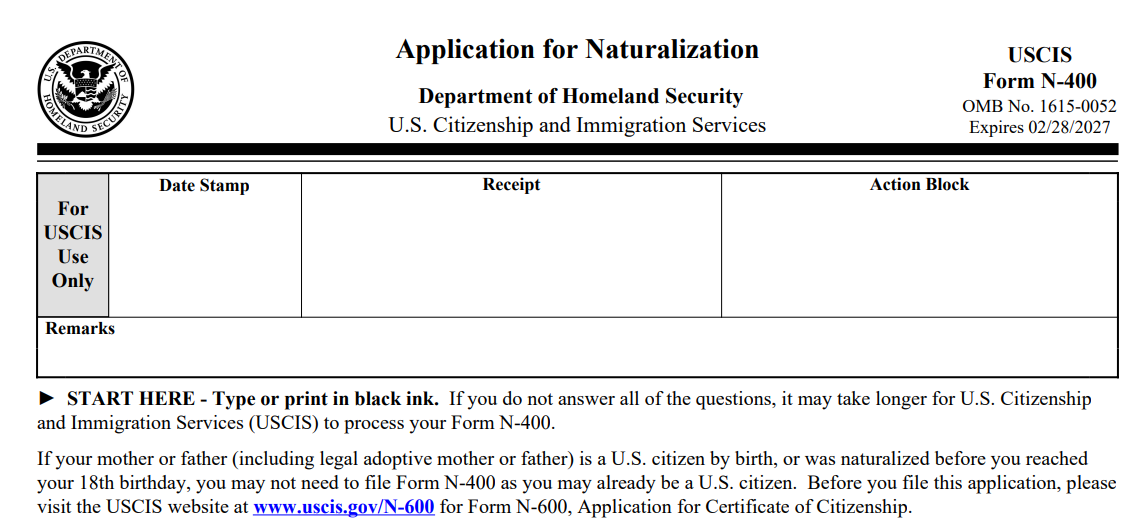
USCIS trimmed Form N-400 to 14 pages in 2024 by removing redundant questions and integrating the reduced-fee request. However, even with a shorter application, most applicants think the hard part is typing in their name, address, A-Number, and green card information. The real risk is giving an incomplete answer, forgetting an old citation, filing too early, or showing up to the interview without the records the USCIS officer needs.
USCIS naturalized 818,500 people in fiscal year 2024, according to its FY 2024 Naturalization Statistics. That is a lot of approvals, but every approval still starts with one accurate naturalization application. At Hacking Immigration Law, LLC, we help you ensure that your path to citizenship is built on a solid foundation from day one.
Key Takeaways:
Avoid costly delays, unnecessary stress, and sudden denials. Let our immigration lawyers oversee every detail of your N-400 filing.
Table of Contents
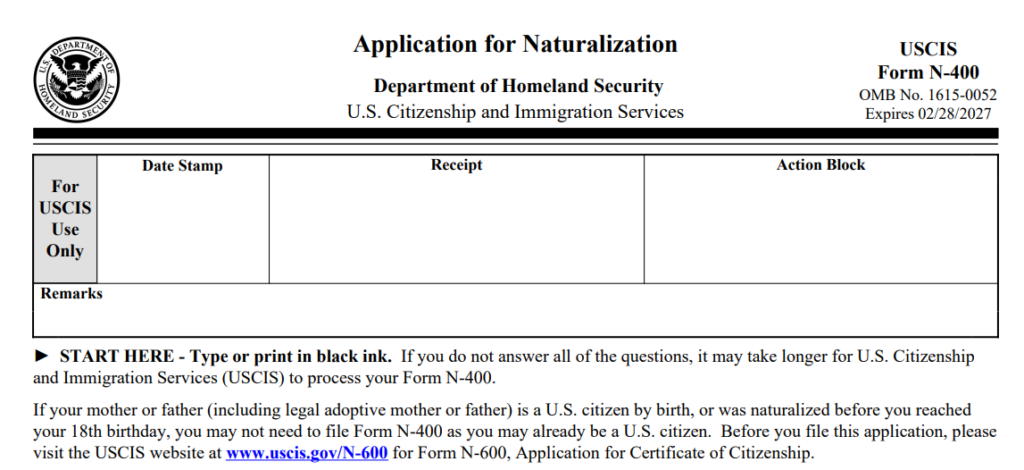
Form N-400, Application for Naturalization, is the USCIS form that eligible lawful permanent residents use to apply for U.S. citizenship. This form asks USCIS to decide whether you meet the eligibility requirements for naturalization. That includes your permanent resident status, residence history, physical presence, continuous residence, marital status, moral character, tax compliance, Selective Service history, and willingness to take the oath of allegiance. USCIS also uses this form to prepare for your biometrics appointment, naturalization interview, civics test, English test, and final decision.
Most applicants file Form N-400 after holding a green card for the required period. Some apply based on marriage to a US citizen. Others apply based on qualifying military service or another naturalization eligibility category.
If you are not sure whether you have reached your eligibility date, here's when you can apply for citizenship before filing.
Gathering documents first helps prevent processing delays, unanswered questions, and interview issues. If you wait until the appointment notice arrives to find old records, you may discover too late that a courthouse, arresting agency, local tax office, or former employer needs time to issue what you need.
Here are the documents you need to gather before you begin with your Form N-400 application:
Note: Supporting documents shape whether the form is accurate, whether the interview goes smoothly, and whether USCIS has enough evidence to approve the case.
You must complete the Form N-400 in order. Skipping around increases the risk of inconsistent answers, especially when travel, residence, employment, marital history, and moral character overlap.
Parts 1 to 3 of Form N-400 identify why you are eligible to file, who you are, and how USCIS should classify your biographic information.
Applicants often make mistakes by choosing the wrong eligibility category or by listing only their current legal name. If you used a maiden name, a prior married name, a shortened name, a spelling variation, or a name on a previous immigration form, include it where Form N400 asks for other names used. USCIS compares this form to prior immigration services records, so unexplained name differences can create questions.
Part 4 of Form N-400 asks for your current mailing address and physical address history.
Your residence history should match your tax records, driver's license records, rent or mortgage statements, bank statements, and prior immigration filings.
Part 5 of Form N-400 asks about current marital status, current spouse, prior marriages, and how each marriage ended. Applicants go wrong by treating prior marriages as irrelevant. USCIS wants the full marital history, including prior marriages that ended in divorce, annulment, or death. Gather the marriage certificate, divorce decree, and death certificates before filing so the names and dates match the official records.
If your naturalization eligibility is based on a marital union with a US citizen, be careful. USCIS may review whether the marital union meets the legal requirements, not just whether a marriage certificate exists.
Part 6 of Form N-400 asks about your children. List all children required by the USCIS instructions, including children living outside the United States, adult children, stepchildren when applicable, adopted children, and children from prior relationships.
Note: If there is a child support order, missed child support payments, wage garnishments, or a signed agreement, those facts may also matter in Part 9. Do not list children in Part 6 and then answer moral character questions as if no child support issue exists.
Part 7 of Form N-400 asks for your employment and educational history.
Your employment and school history should cover the requested period without unexplained gaps. If you were unemployed, self-employed, retired, or caring for family, say so clearly rather than leaving blank periods.
Part 8 of Form N-400 asks about trips outside the United States. This section matters because USCIS uses it to review continuous residence and physical presence.
List every trip outside the United States during the required period, including short trips. Travel dates must be accurate. Use passports, airline records, I-94 history, calendar records, and old emails to reconstruct dates. Do not guess if travel was close to six months or if you spent significant time abroad.
Part 9 of Form N-400 is the trickiest part because it reads like a long list of yes-or-no questions. It is really a moral character, security, criminal history, tax, oath, and compliance screening section.
Here are the relevant sections you must read carefully:
Read each question slowly. A “no” answer that should have been “yes” can be worse than the original incident because it creates a truthfulness problem.
Recent enforcement cases show why the Part 12 questions on Form N400 cannot be treated like routine paperwork. In a Justice Department case, defendants were charged with illegally voting in a federal election and making false statements while applying for naturalization. That kind of allegation goes directly to the N-400 questions about voting, claiming U.S. citizenship, truthfulness, and good moral character.
If you ever registered to vote, voted, checked a citizenship box, or made a statement to a government agency that may have been wrong, get legal advice before filing Form N-400.
Part 10 allows eligible applicants to apply for a reduced filing fee directly on Form N-400, rather than filing a separate form for income-based fee assistance.
If your household income is at or below a specific percentage of the Federal Poverty Guidelines (typically between 150% and 400% of the FPG), you may qualify to pay a reduced naturalization fee. If requesting a 50% Reduced Fee, complete Part 10 and attach supporting financial documentation. However, if requesting a Full Fee Waiver (100% free), do not use Part 10; you must complete and attach a separate Form I-912.
Parts 11 to 16 of Form N-400 cover the applicant’s contact information, oath-related requirements, your signature, interpreter information, preparer information, and signatures completed during the interview. Review these sections before submission, but do not sign sections that are meant to be signed later in front of the USCIS officer.
Before you submit the form electronically or mail a paper form, review the form edition date on the USCIS website, confirm you are using the current edition, and keep a complete copy of the final naturalization application.
Most applicants can file the N-400 online or by mail.
Online filing is often faster to organize because you can upload supporting documents, pay electronically, and receive case updates in your online account. It also reduces the risk of mailing problems.
Paper filing is the best choice for some applicants, including those requesting a fee waiver or a reduced fee. Some applicants also prefer paper because they want to assemble a full packet with money order receipts, certified records, and a complete copy.
If you mail the N-400, use trackable mail, and keep your own copy of everything you filed. Do not send your only copy of important records unless USCIS specifically requires an original.
The current N-400 filing fee depends on how you file. USCIS lists the general Form N-400 fee as $710 for online filing and $760 for paper filing. The biometrics fee is included in those current fee amounts, so most applicants do not pay a separate biometrics fee.
USCIS also lists a reduced fee of $380 for paper filing if the applicant’s documented annual household income is not more than 400 percent of the Federal Poverty Guidelines and the applicant submits supporting documentation with the application. Take note that paper filing is your only option if you are requesting a reduced fee.
Some applicants may qualify for a full fee waiver. A fee waiver request usually requires Form I-912 or a written request that meets USCIS instructions. If USCIS accepts the fee waiver, the fee is $0. If USCIS rejects the fee waiver, the application may be rejected or delayed.
Applicants filing under qualifying military service provisions may also be eligible for a $0 filing fee.
Some applicants may file Form N-400 up to 90 calendar days before completing the required continuous residence period. Filing early can help move the case forward, but even one day too early can result in the application being rejected or returned.
Before filing, confirm your eligibility date. Count carefully from the correct date on your permanent resident card and apply the rule based on USCIS instructions. If there is any doubt about the date, wait or get legal advice before submitting the form.
After you file Form N-400, USCIS sends a receipt notice. If you filed online, you may see the receipt in your USCIS online account and may also receive notices by mail or text message if you opted into alerts.
USCIS may then schedule a biometrics appointment at an Application Support Center. The appointment notice will give the scheduled date, time, and location. Attend the scheduled appointment unless USCIS approves a reschedule.
Next, USCIS sends an interview notice for the naturalization interview. At the interview, a USCIS officer reviews your N-400, asks about your answers, tests your English and civics knowledge, and reviews the required documents.
After the interview, USCIS may approve the application, continue the case for more evidence, or deny it. USCIS reported that 818,500 people naturalized in FY 2024, and that the 3-year total was more than 2.6 million new citizens. Those approvals show the system works for many applicants, but only when USCIS can confirm eligibility and resolve any issues.
If USCIS approves the case, you will attend the oath ceremony or naturalization ceremony and become a US citizen after taking the oath. Read more about the oath ceremony. If the case is denied, review your options here: if your N-400 is denied.
At Hacking Immigration Law, LLC, we help applicants prepare for interviews, respond to USCIS concerns, and evaluate next steps.
You may be able to correct or update Form N-400 after filing, but the right method depends on the issue. Some updates can be made during the naturalization interview, such as a new address, new travel information, or a recent job change. Larger problems may require written evidence, a legal strategy, or a decision about whether to continue the case.
Withdrawing an N-400 is different from ignoring it. If you simply stop responding, miss appointments, or let the case die, USCIS may deny the application or create a record that causes problems later. A proper withdrawal usually means sending a clear written request to USCIS that identifies the case and explains that you want to withdraw it.
Form N-400 is used by eligible lawful permanent residents to apply for U.S. citizenship through naturalization. USCIS uses the form to review naturalization eligibility, residence history, travel, moral character, tax compliance, criminal history, and readiness for the oath.
According to the USCIS Form G-1055 Fee Schedule, the N-400 costs $710 online or $760 by mail for the general filing category. The reduced fee is $380 for qualifying paper filers, and some applicants may qualify for a fee waiver or military service fee exemption.
Online filing is often easier for applicants who can pay the regular fee, upload supporting documents, and manage notices through a USCIS online account. Paper filing is required if you request a reduced fee or a fee waiver.
After filing Form N400, USCIS issues a receipt notice, schedules biometrics when required, sends an interview notice, conducts the naturalization interview, makes a decision, and, if the application is approved, schedules the oath ceremony. The case can also be continued or denied if USCIS needs additional evidence or identifies an eligibility issue.
No, you generally do not need your spouse’s permission to file Form N-400.
You can usually travel while your N-400 is pending, but travel can still affect continuous residence, physical presence, interview scheduling, and oath ceremony timing. Long trips or repeated trips can create problems.
Form N-400 is for eligible green card holders applying to become naturalized U.S. citizens. Form N-600 is for people who may already be U.S. citizens and need a Certificate of Citizenship.
Before you submit your application, get expert eyes on your file. Consult our immigration lawyers to protect your path to naturalization.