As of 2023, the U.S. Citizenship and Immigration Services (USCIS) continues to process over 400,000 I-864 Affidavit of Support forms annually. Despite discussions and legal challenges surrounding the enforceability of this form, it remains a critical part of the immigration process for family-based immigrants. According to USCIS data, failure to properly submit the I-864 or errors in its completion are among the most common reasons for delays or denials in family-based immigration cases. Therefore, ensuring this form is filled out accurately and timely is essential for applicants seeking to avoid any delays in their immigration process.
Do I still have to file an Affidavit of Support in a family-based Green Card case?
Hi, I'm Jim Hacking, an immigration lawyer practicing law throughout the United States out of our office here in St Louis, Missouri. We've been shooting a lot of videos about the I-864 and the I-944. Of course, the I-864 is the Affidavit of Support, and the I-944 is this new Declaration of Self-Sufficiency.
Key takeaways:
• I-864 is still enforceable: Despite confusion, courts continue to uphold the Affidavit of Support as a binding contract.
• Divorce doesn’t end obligations: Sponsors remain financially responsible until specific legal conditions are met (e.g., 40 work quarters, citizenship).
• Legal challenges are growing: Courts are exploring defenses like prenuptial waivers and income offsets, but outcomes vary.
Need help with your immigration case? We can help.
Table of Contents
When a US citizen or lawful permanent resident seeks to sponsor their family member or loved ones for an immigrant visa or status adjustment, they have to leap over the hurdle of the dreaded public charge issue. And historically, this problem or this concern on the part of the federal government has been solved by the US citizen filing a separate form of an I-864.
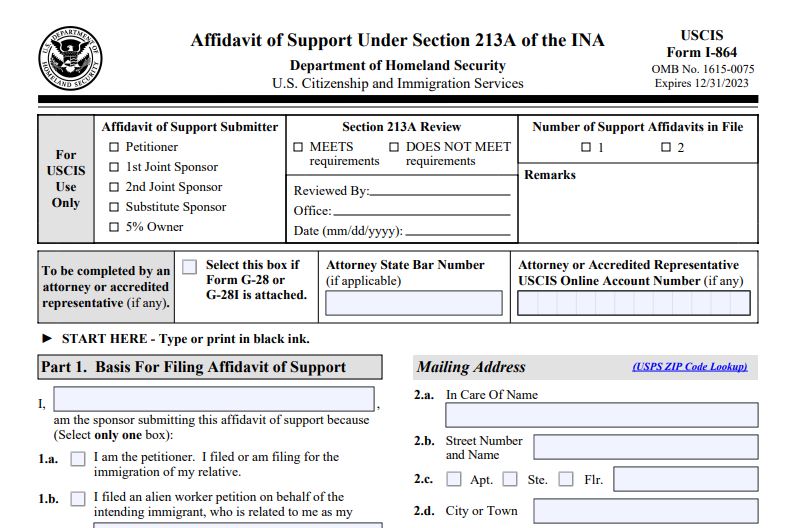
The I-864 is an Affidavit of Support. It's about a 15-page form that sets forth all the information about the sponsoring citizen, Green Card holder, or sponsor’s employment and financial status.
So you're going to put in your tax returns and submit your W-2s and all your proof of income. You're going to submit how much money you've made in each of the last three years, and there is going to be a determination as to whether or not you make enough to support your foreign national household member. Typically, this was 125% of the federal poverty guidelines.
To take on this role, you'll need to fulfill a couple of requirements.
• Firstly, you must be at least 18 years old and hold either U.S. citizenship or permanent residence.
• Secondly, you'll need a United States domicile to call your "headquarters." In most cases, this means living within the U.S. or one of its territories/possessions.
• Lastly, the INA's Section 213A offers options for a "joint sponsor" and a "substitute sponsor" when necessary.
So as long as the US citizen, permanent resident, or Green Card holder who is sponsoring the foreign national for an immigration benefit made enough money, then they were going to be the sponsor all by themselves. If not, they were going to need a co-sponsor.
Picture this: You're a proud sponsor, taking on the noble responsibility of financially supporting one of your family members. You've signed an affidavit of support, a legally binding commitment that lasts until they become U.S. citizens, work 40 quarters, or, sadly, one of you passes away. Keep in mind that bidding farewell at a marriage doesn't dissolve this duty.
A co-sponsor is someone who says, "Well, if..." So, let's say we have Abdul. Abdul's a US citizen, and he wants to sponsor his wife, Amany, to come to the United States. And Amany's overseas or Amany's here in the United States, and wants to get a Green Card. And Abdul makes, let's say, $45,000 a year in each of the last three years. Abdul has no dependents. So Abdul could, on his own, be Amany's financial sponsor. This is under the old system.
Now, if Abdul only made $25,000 a year, that's not going to be 125% of the poverty guidelines, and Abdul is going to need a co-sponsor. So that can be a US citizen or Green Card holder who says that if Amany comes to the United States, gets a Green Card, gets public benefits, and Amani can't pay them back, and Abdul can't pay them back, then I, the co-sponsor, we'll call him Fred. Fred says, "I will stand in for Abdul. I'm a US citizen. Here are my taxes. Here is my W2's. I will sign an Affidavit of Support to back up Abdul." And typically, that's how the concern over a public charge was solved.
Immigration Answers Show - JOIN US
The specific immigrants who are required to submit Form I-864 include:
• Immediate relatives of U.S. citizens (including spouses, parents, and unmarried children under the age of 21)
• Family-sponsored immigrants in certain categories (household members including spouses, unmarried children of U.S. citizens and lawful permanent residents, married children, and sisters and brothers of U.S citizens)
• Employment-based immigrants in certain categories (including some employment-based preference categories and certain special immigrants with a significant ownership interest)
However, there's no need for an affidavit of support if an individual can prove that they:
• have worked 40 qualifying quarters, as per the Social Security Act Title II
• are credited with 40 qualifying quarters under the same act
• have an approved Form I-360, Petition for Amerasian, Special Immigrant as a self-petitioning widower or widow.
• have an approved Form I-360 as a battered child or spouse
• happen to be the child of a U.S. citizen and will automatically become a citizen if granted permanent residence (on or after Feb 27, 2001, as amended by the “Child Citizenship Act of 2000”).
Here are the steps to file an Affidavit of Support:
You will need to obtain Form I-864, Affidavit of Support, from the U.S. Citizenship and Immigration Services (USCIS) website. You will also need to download and complete the instructions for the form.
You will need to provide supporting documents that demonstrate your own financial resources and ability to support the intending immigrant, including:
• Federal income tax returns. Provide copies of your federal tax returns for the most recent 3 years. This will demonstrate your income over the past few years.
• W-2 forms. Include copies of your W-2 forms for the same three-year period. These forms will help to verify that you have been employed during that time.
• Pay stubs. Provide copies of your pay stubs for the current year. This will show your current income.
• Bank statements. Provide bank statements that show your account balances for the past year.
• Proof of assets. If you have significant assets, such as stocks, bonds, or real estate, provide documentation to show their value. This can include deeds, titles, or account statements.
• Other income verification. There could be a minimum income requirement, so provide income from sources other than your job, such as rental income or retirement benefits.
Remember that being a primary sponsor means you accept financial responsibility for your sponsored immigrant.
Complete the Affidavit of Support form and make sure that you have signed and dated it. You will also need to include all supporting documents with the form.
Once you have completed the form, you can submit the Affidavit of Support to U.S. Citizenship and Immigration Services.
Beware when submitting Form I-864: if you intentionally falsify or hide crucial facts, you're in deep trouble. Not only will your form be denied, but also any immigration benefits you seek, not to mention harsh penalties under the law and even possible criminal prosecution.
Honesty is the best policy, for faking information can land you in severe penalties with the US justice system.
In addition, USCIS National Visa Center has also mentioned that:
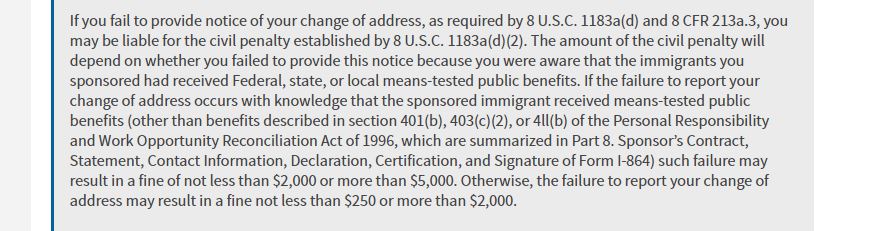 Image Source
After you have submitted the Affidavit of Support, USCIS will review the form and any other supporting documents first. If everything is in order, they will notify you of their decision.
In summary, it’s important to follow all instructions carefully. Plus, ensure that all required information and documents are included.
To make sure everything is in line, seek advice from an immigration attorney. In such a way, you can get the assistance you need.
• USCIS (for adjustment of status): Two to four months.
• National Visa Center: One to three months after document submission.
• Immigrant visa interview: Scheduled within 30-60 days after I-864 gets approved.
Delays can happen when the form is incomplete, missing financial evidence, or the correct form version is not used.
• The minimum annual income is needed based on the sponsor’s household size.
• Submit your recent federal tax return, W-2s, and proof of current employment.
If the sponsor’s income isn’t enough, they should supplement their income by:
• Including the household income from a sponsor’s household member.
• Using the cash value of assets, such as savings, stocks, or property. The minimum cash value must be thoroughly documented.
• Using income deeming, or calculating income that one assumingly receive from financial assets regardless of the actual income, from the spouse, dependents, or adult children.
For U.S. citizens sponsoring other people, assets must be five times the difference between actual income and the income requirement. However, it’s three times the difference for permanent residents.
If you’re serving in the armed forces and your dependents are your spouse or a minor child, the minimum annual income requirement is 100% based on the Federal Poverty Guidelines.
You’re exempt from filing Form I-864 if your residence abroad is temporary and you’re working for a public international organization, military, or government agency and plan to return to the U.S.
• Submit the correct form.
• Double-check all entries and use consistent names and details on all forms, especially for the alien relative.
• Prepare and provide all necessary financial documents.
Now the Trump administration has greatly expanded the use of the public charge definition. They've released an 850 or 890-page rule on this, and there's a new form called an I-944.
So some people are wondering, well, with this I-944, which is much more focused on the foreign national's ability to get financial support for themselves, whether they're going to be financially solvent, whether they can earn a living in the United States, whether they can provide for themselves. The I-944 is much more detailed. It's a real pain in the butt. We're already sending out our first few cases with the I-944.
But some people are wondering, does that mean we don't have to do the Affidavit of Support anymore? Well, of course not, it doesn't, because USCIS is trying to find multiple ways to screw you and to prevent you from getting that Green Card. So you not only have to do the I-944 under new rules, but you still have to go back and do the I-864. The Affidavit of Support. You know the one I mean. I'm sort of fried by throwing out all these numbers and dates and all that stuff. So I hope you forgive me.
But the Affidavit of Support is still a necessary requirement, and you still have to submit it. You still have to have a co-sponsor if possible. So, in other words, now USCIS is looking at not only the US citizen or Green Card holder's ability to financially support the foreign national but also the I-944, the ability of the foreign national themselves to support themselves. So it's a much more complicated approach.
But if you operate from the assumption that USCIS is always trying to figure out ways to screw you, then you're going to understand why you have to do both forms. So just think of it that way. If they can find something to nitpick about, complain about, or deny your case's worth, they will do it both ways, either with the I-864 or the I-944.
I hope this answers your questions about that. You do need both forms. You might need help doing both forms. I'm pretty much convinced that most people can't pull off this I-944 on their own. It's not going to be easy. It's not going to be fun. And having now had our office go through this a few times, it's a lot of work. I can tell you that.
If you're considering taking advantage of this program for yourself or someone close to you, it's important that you are familiar with the requirements and regulations. Since each case is different, seeking professional advice ahead of time can save time and hassle.
So if you have questions about the interplay of the Affidavit of Support and the petition for self-sufficiency, call us at (314) 325-1492. You can also email us at [email protected]. Be sure to join us in our Facebook group, which is called Immigrant Home. Don't hesitate to turn to experts!
Thanks a lot. Have a great day.