Filing Form I-130 is the critical first step in bringing your family together, but a single misstep can lead to a frustrating denial. Here is what you need to know to file correctly, avoid common traps, and fight back if your petition gets stuck or rejected.
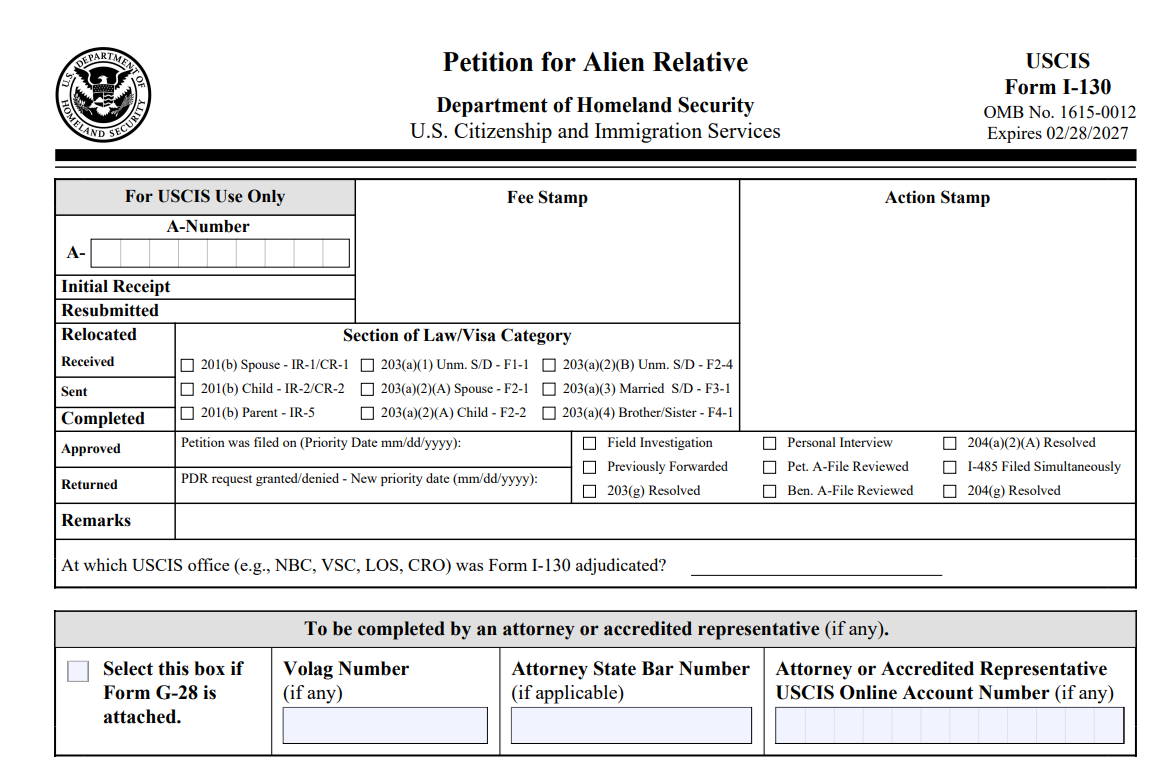
Form I-130 is the family-based immigration petition that a U.S. citizen or lawful permanent resident uses to ask USCIS to recognize a qualifying family relationship with an alien relative. It is often the first step toward a green card, but the petition itself does not confer lawful status, a visa, or work authorization on the beneficiary.
If you're filing for a spouse, parent, child, sibling, adopted child, or another eligible relative, the details matter. USCIS looks at the relationship, the petitioner's status, the beneficiary's documents, and whether the story is consistent. A weak petition can slow the process, prompt a request for additional evidence, or result in denial.
At Hacking Immigration Law, LLC., we help families navigate the complexities of petitioning for loved ones by ensuring every document is precise, accurate, and built to withstand strict USCIS scrutiny.
Key takeaways:
If your I-130 case involves a prior denial, embassy refusal, missing documents, or a complicated family history, don't guess your way through it.
Table of Contents
Form I-130, Petition for Alien Relative, requests USCIS to confirm that a qualifying family relationship exists between the petitioner and the beneficiary.
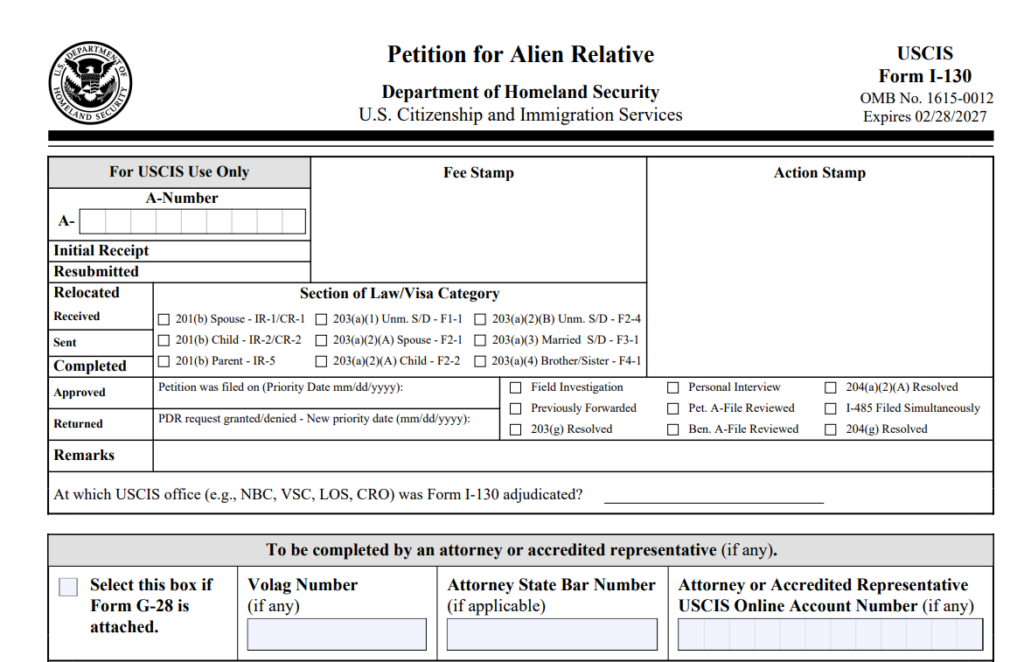
Form I-130 does not approve the green card application on its own. It only establishes that the family member may qualify for the next stage of the immigration process, such as adjustment of status inside the United States or consular processing through a U.S. embassy abroad. This distinction matters.
When USCIS approves the petition, USCIS confirms the relationship. The beneficiary still has to complete the next stage, submit the required documents, remain eligible, and prove admissibility before becoming a permanent resident.
U.S. citizens or permanent residents can file Form I-130 only for certain relatives recognized under U.S. immigration law. The petitioner must prove both their own status and the family relationship with the beneficiary.
U.S. citizens can usually petition for a spouse, parents, children, unmarried children, married children, and siblings. Lawful permanent residents and green card holders have narrower options.
The basic eligible relative categories include:
A grandparent, cousin, aunt, uncle, or friend generally cannot be the basis for a Form I-130 petition. The law requires a qualifying family relationship, not just a close personal bond.
Trying to navigate the complicated world of U.S. immigration and citizenship can be tough. Get the help you need from Hacking Law Practice, LLC.
Immediate relatives of U.S. citizens usually move faster because there is no annual numerical cap on immigrant visas for that category. This group includes a U.S. citizen's spouse, unmarried child under 21, and parent if the U.S. citizen is at least 21.
Family preference relatives are still eligible in certain cases. However, they may face long waits before an immigrant visa becomes available. This category can include siblings, married children of U.S. citizens, and spouses or unmarried children of lawful permanent residents.
Processing time depends on the family category, the petitioner's status, the beneficiary's home country, USCIS workload, and whether the petition has errors or missing proof. A spouse case can move much faster than a sibling case, but no category is immune to delay.
The documents for Form I-130 must prove three things:
Strong supporting evidence makes it easier for USCIS to understand the case and reduces the risk of a request for additional evidence.
Common supporting documents include:
Every document should be readable, complete, and consistent with the form. If a date, name, place of birth, marital information, or relationship detail does not match, explain it and include proof where possible.
A petitioner can usually file Form I-130 online or by mail to the correct USCIS filing address. The right filing method depends on the case type, the forms being filed together, and the current instructions on the USCIS website.
Online filing allows the petitioner to create an online account, submit the form, upload supporting evidence, and receive electronic case updates. Mail filing requires the petitioner to send the signed form, filing fee, and supporting documents to the correct USCIS lockbox or service center.
Some I-130 packages are mailed to a lockbox, such as the Phoenix Lockbox, depending on the petitioner's location and whether other forms are filed at the same time. Verify the current address listed on the USCIS website before mailing the package, as lockbox addresses can change.
Before filing, check for these common mistakes:
An unsigned form or wrong fee can cause USCIS to reject the filing before it even begins. A thin or inconsistent petition can move forward, but it may lead to delays, requests for additional evidence, or denial.
Filling out Form I-130 may look simple, but the form is only one part of the case. The risk is not just typing the wrong answer. The bigger risk is failing to spot a problem before USCIS does.
Every family case has facts that affect strategy. A prior visa denial, unlawful presence, quick marriage after entry, missing birth records, adoption history, criminal issue, previous spouse petition, or embassy refusal can change how the petition should be prepared.
Whether your case is routine or highly complex, working with a Green Card lawyer from the beginning is essential. Professional guidance ensures straightforward applications avoid hidden pitfalls, while complex cases get the strategic preparation they need, saving you from the immense difficulty of trying to repair a damaged record after a USCIS denial.
Filing Form I-130 can be treated as evidence of immigrant intent because the petition indicates that the beneficiary may intend to immigrate to the United States. That issue matters most when the beneficiary later applies for a non-immigrant visa, such as a visitor visa or student visa.
Immigrant intent means the person intends to live permanently in the United States. A non-immigrant visa usually requires the person to prove they plan to return to their home country after a temporary stay.
If a spouse, parent, child, or sibling has a pending or approved I-130 petition, a consular officer may question whether the person truly intends to visit temporarily. In some cases, it may be smarter to handle a short visit before filing the immigrant petition, but that decision depends on the facts.
When USCIS approves Form I-130, the next step depends on the beneficiary's location, visa availability, and immigration status. Approval means USCIS recognizes the family relationship. It does not automatically issue a green card.
If the beneficiary is in the United States and eligible to adjust status, they may proceed with the green card application through USCIS. Immediate relatives of U.S. citizens are often in the strongest position for this route, but eligibility still depends on the full immigration history.
If the beneficiary is not in the United States, the case moves to the National Visa Center for consular processing. The National Visa Center collects fees, civil documents, financial documents, and the immigrant visa application before scheduling the embassy interview.
At the consular processing stage, the beneficiary may need to submit documents such as a passport, birth certificate, police certificates, marriage certificate, financial sponsorship documents, and translations. The embassy can still request additional evidence before issuing the immigrant visa.
Two I-130 petitions can sometimes exist for the same beneficiary if different eligible petitioners have separate qualifying relationships.
In this video, you can see how a U.S. citizen child over 21 can petition for his parent, and the U.S. citizen spouse can also petition for that same person.
However, that does not mean filing two petitions is always wise. Multiple petitions can confuse USCIS, incur additional filing fees, and create unnecessary complexity if both cases move forward simultaneously.
A second petition may make sense only when there is a strategic reason, such as a different category that may move faster or avoid a specific restriction. Before filing a second petition, compare the category, processing time, filing fee, strength of the evidence, and the potential confusion it could create.
If you're filing Form I-130, dealing with a denial, or trying to move a refused embassy case forward, get legal help before the record gets messier.
USCIS looks closely at spousal petitions because marriage fraud is a known concern in family immigration cases. A real marriage is not just a valid marriage certificate. USCIS wants proof that the couple entered the marriage in good faith and built a life together.
Fraud indicators do not automatically mean USCIS denies the petition. They are warning signs that may lead to more questions, a deeper review, a tough interview, or a fraud unit referral.
Common issues that can trigger scrutiny include:
USCIS should look at the full case, not one fact in isolation. A large age gap, cultural difference, or low income should not automatically prove fraud, but the petition still needs strong supporting evidence to prove the marriage is real.
A strong marriage-based I-130 petition gives USCIS a clear picture of the relationship from the beginning. The goal is to prove the marriage is legally valid and genuine, not just documented on paper.
Useful supporting evidence may include:
If the couple has limited joint documents, secondary evidence can help. School records, religious records, affidavits, travel receipts, photos with family, and written statements can fill gaps, but they should be organized and specific.
If USCIS denies Form I-130, the first step is to read the denial notice carefully and identify the exact reason. USCIS denies petitions for different reasons, and the best response depends on what went wrong.
Possible reasons include:
If USCIS denies the petition because a fixable document was missing, a new filing may be faster and stronger than an appeal. If USCIS denies the petition based on a legal or factual finding, the case needs a more careful strategy.
Appealing a denied I-130 is not always the best choice. Appeals can take a long time, and they may not solve the core problem if the original petition was weak, incomplete, or missing key evidence.
In many cases, a new I-130 petition with better supporting evidence may be more practical than appealing. This is especially true when the denial came from a fixable problem, such as missing documents or weak proof of the relationship.
An appeal may make sense when USCIS made a clear legal or factual error, and the record already contains enough evidence to support approval. Before choosing appeal or refiling, compare the denial reason, deadline, evidence, processing time, and immigration status risks.
An embassy refusal after I-130 approval is different from a USCIS denial. The petition may still be valid even if the embassy refuses the immigrant visa under administrative processing or requests more evidence.
A 221(g) refusal often means the consular officer needs additional documents, further review, or additional processing before making a final decision. In that situation, filing a second I-130 can create confusion and may hurt the case if the first petition has not been revoked. Instead of refiling, the better strategy is often to seek a final decision on the existing petition, including filing a mandamus action to compel action if the case remains unreasonably delayed.
The right approach depends on whether the embassy returned the petition to USCIS, whether USCIS issued a notice of intent to revoke, and whether the beneficiary continues to follow up.
A second I-130 may be worth considering if the first petition was revoked or denied for a fixable reason, or is tied to a category that no longer fits the case. It should not be filed just because the embassy is slow or the family is frustrated.
Before filing again, ask these questions:
If the first case is still valid, the goal may be to move that case forward rather than start over. If USCIS denies or revokes the original petition, a new petition may be useful only when it directly addresses the underlying cause of the problem.
Does Form I-130 give the beneficiary legal status?
No. Form I-130 does not give the beneficiary legal status, a green card, work authorization, or permission to stay in the United States. It only asks USCIS to recognize the family relationship for immigration purposes.
Can a lawful permanent resident file Form I-130 for parents?
No. A lawful permanent resident cannot file Form I-130 for parents. A U.S. citizen who is at least 21 can usually petition for their parents as immediate relatives.
Can green card holders file for unmarried children?
Yes. Green card holders can generally file Form I-130 for a spouse and unmarried children. The category and wait time depend on the beneficiary's age and other factors.
What happens after USCIS approves the I-130 petition?
After USCIS approves the petition, the case may move to adjustment of status with USCIS or consular processing through the National Visa Center and a U.S. embassy. The next step depends on the beneficiary's location, status, and visa availability.
Should I file another I-130 if the first one was denied?
Sometimes, but not always. If USCIS denies the first petition because evidence was missing or the filing had a fixable defect, a new petition may be stronger than an appeal. If the first petition was approved and the embassy only refused the visa under administrative processing, filing another petition may create more problems.
Form I-130 is the first step for many family-based green card cases, but it is not just paperwork. It is the foundation for proving a family relationship, moving the case through USCIS, and preparing for the National Visa Center, consular processing, or adjustment of status.
If USCIS approves the petition, the beneficiary must still complete the next stage before receiving a green card or an immigrant visa. If USCIS denies the petition or the embassy refuses the case after approval, the family should slow down, diagnose the reason, and choose the next move carefully.
A second petition, an appeal, or a lawsuit can all be the wrong move if the problem has not been identified first. The strongest cases start with the right documents, a clear timeline, and evidence that proves the relationship from the beginning.
If you're filing Form I-130, dealing with a denial, or trying to move a refused embassy case forward, get legal help before the record gets messier.