Key Takeaways:
If your citizenship document is missing or contains incorrect information, you can ask U.S. Citizenship and Immigration Services (USCIS) to issue a replacement or corrected version using Form N-565. Applications are accepted online and by mail.
Losing a certificate can feel alarming. You may need it for your work, to receive benefits, or for another official purpose. But losing the paper doesn’t erase your U.S. citizenship. Form N-565 replaces proof that USCIS already issued. But it doesn’t grant citizenship.
This guide explains eligibility, costs, evidence, filing, and what you can do while you wait.
Table of Contents
Dealing with a ruined certificate or one with the wrong details? Hacking Immigration Law, LLC can help you navigate the Form N-565 requirements.
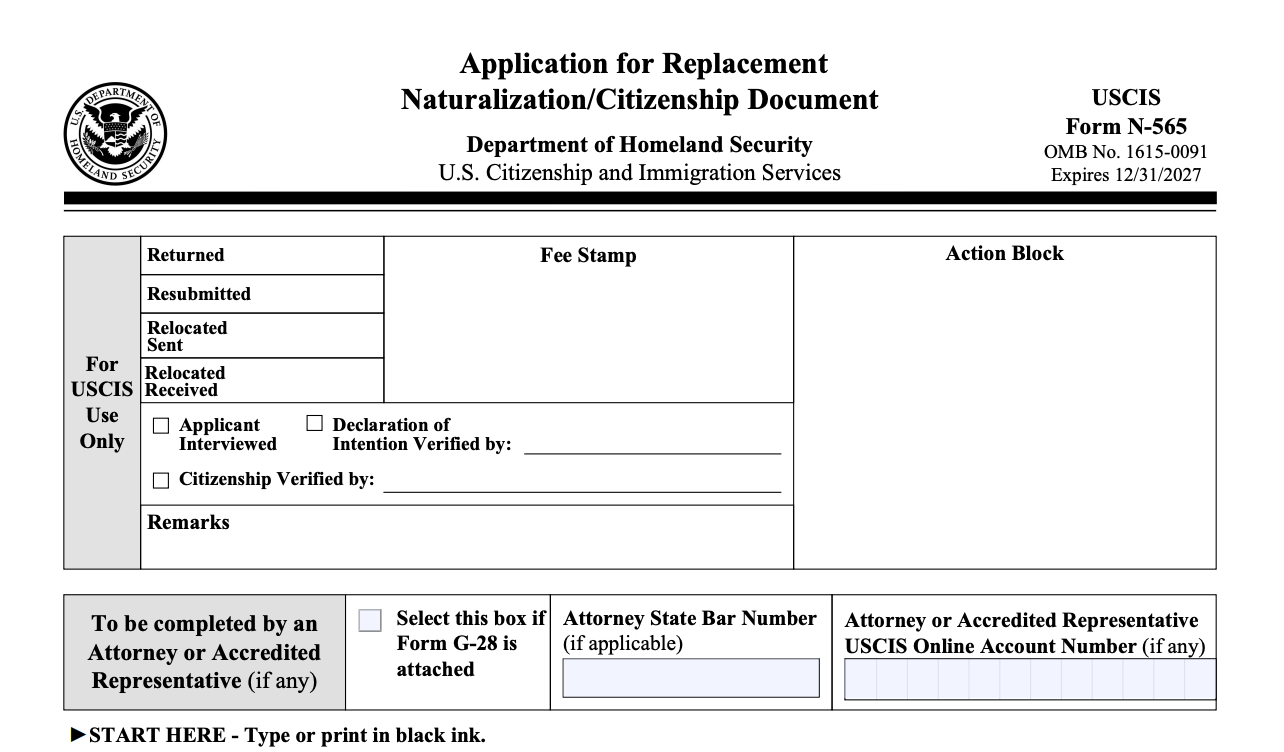
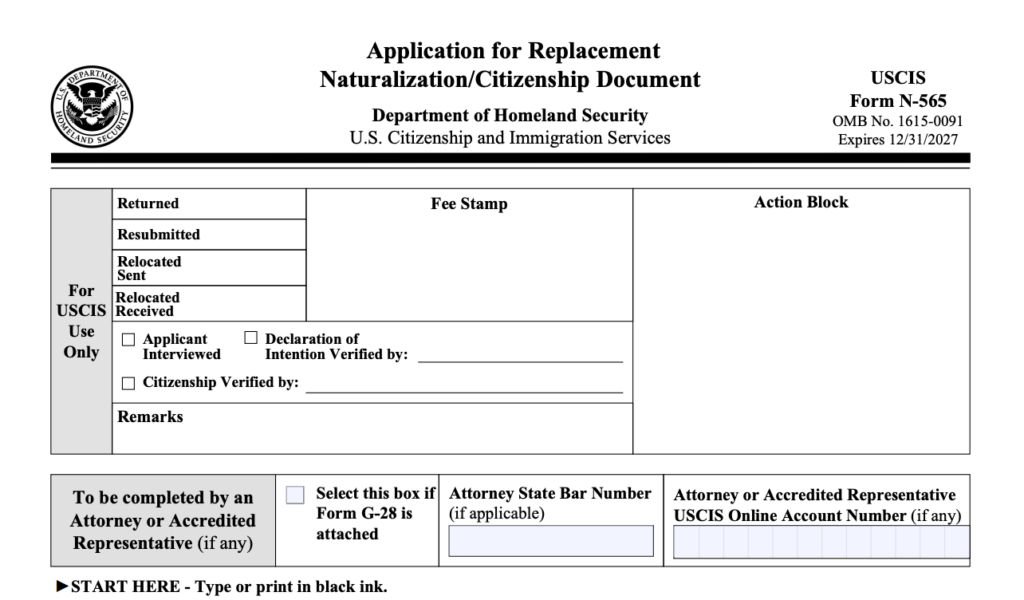
Known as the Application for Replacement Naturalization or Citizenship Document, Form N-565 allows eligible applicants to request a new or corrected version of certain citizenship and naturalization records maintained by U.S. Citizenship and Immigration Services (USCIS). It replaces four documents and doesn't grant citizenship.
| Document | Who usually has it |
| Certificate of Citizenship | People who became citizens through a U.S. citizen parent |
| Certificate of Naturalization | People who completed the naturalization process and took the oath |
| Declaration of Intention | An older document showing intent to naturalize |
| Repatriation Certificate | Former U.S. citizens who regained citizenship |
Form N-565 is only for U.S. citizens who hold or were previously issued one of these certificates. Any naturalization document or citizenship record USCIS gave you qualifies. You can also request a special certificate of naturalization for recognition by a foreign country.
A Certificate of Citizenship serves as evidence that a person acquired U.S. citizenship through a parent, either at birth outside the United States or during childhood after the parent became a naturalized citizen.
A naturalization certificate means you took the oath yourself after filing Form N-400. Both are replaced with the same form.
USCIS accepts these reasons for filing:
Legal name changes require documentation to support the request. Your marriage certificate, a court order, and a divorce decree are applicable. You can request a correction for USCIS clerical errors at no cost. If the mistake was yours, the regular fee applies.
Here’s how to file Form N-565:
Start by downloading the form and following the instructions on the official USCIS website.
| Reason for filing | Evidence to include |
| Lost, stolen, or destroyed | A copy of the previous certificate, if available, plus a law-enforcement report and/or sworn statement describing what happened and efforts to recover it |
| Damaged or mutilated | The damaged original document |
| USCIS clerical error | The incorrect record and evidence showing the correct information |
| Legal name change | The prior record plus a marriage record, divorce decree, annulment decree, or court order |
| Qualifying birth-date change | The prior Certificate of Citizenship plus a qualifying court order or government vital record |
| Marital-status change | A marriage record, divorce decree, annulment decree, or spouse’s death record, as applicable |
A birth certificate can support identity or citizenship in some situations, but it doesn’t replace evidence specifically required for the N-565 request. USCIS generally asks applicants to submit copies unless the instructions specifically require an original. Don’t send an original document unnecessarily. USCIS may request one later if needed.
Also, don’t assume every applicant must provide two passport-style photographs or a separate government-issued photo ID. Requirements depend on the applicable instructions and circumstances.
USCIS offers two submission options for Form N-565: completing the process through an online account or sending a completed paper form by mail.
Filing Online:
Filing by Mail:
For paper filing, use the mailing address and accepted payment method. Keep a copy of the completed form and evidence, along with proof of delivery from the postal service.
USCIS sends a receipt notice within 2 to 4 weeks after filing. Use your receipt number to check your case status.
Not sure your evidence will hold up? Let an attorney look it over first, so your replacement certificate request goes in right.
The filing fee depends on your filing method and eligibility for an exemption.
| Filing option | Standard fee |
| Online filing | $505 |
| Paper filing | $555 |
| Qualifying USCIS error correction | $0 |
| Approved fee waiver | $0 |
Source: USCIS fee schedule, Form G-1055, available in October 2026.
Online filing costs $50 less than filing by mail. However, you must follow the specific instructions for your case. Some applicants qualify for a fee waiver based on the financial and other eligibility requirements in USCIS policy. If you qualify for a waiver, you typically need to submit a paper application instead of submitting your application electronically.
For a paper application, use the correct mailing address and accepted payment method listed in the current instructions. Keep a copy of the completed form and evidence, along with proof of delivery from the postal service if you mail your package.
Always confirm the amount before filing. An incorrect fee can cause USCIS to reject the application rather than process it.
USCIS historical data shows that Form N-565 processing times have changed over recent fiscal years. The historical median increased from 4.9 months in FY 2025 to 7.3 months in FY 2026 through August 30, 2026.
| Fiscal year | Historical median processing time |
| FY 2023 | 8.1 months |
| FY 2024 | 5.6 months |
| FY 2025 | 4.9 months |
| FY 2026 through August 30, 2026 | 7.3 months |
Source: USCIS Historical National Median Processing Times, data available through August 30, 2026.
A median represents the time it took USCIS to complete half of the cases in the measured group. It doesn’t guarantee that your application will be decided within that period. Workload, evidence requests, and individual circumstances can affect your timeline.
As of October 2026, the processing time for Form N-565 is approximately 8.5 to 10 months. After filing, USCIS generally sends a receipt notice confirming that it received your application. Keep the receipt number so you can track updates through the USCIS case status tool.
USCIS first accepts the submission and issues a receipt notice with a tracking number. USCIS may ask you to provide biometric information, submit supporting documents, or attend an interview as part of the review process. It's usually scheduled 4 to 6 weeks after filing, and you'll get an appointment notice with the date, time, and location.
USCIS may also require fingerprints, a photograph, or a signature at any time to verify identity and complete security checks. If you receive a request for additional information, submit the required materials before the deadline to avoid unnecessary processing delays. Keep your mailing address current, including after a move.
Why waiting becomes stressful:
You may discover the missing record only when an employer, benefits office, foreign government, or passport agency asks for proof. A filing receipt confirms that USCIS received a request, but it’s not the requested proof of citizenship. Starting with the wrong evidence can leave the urgent problem unresolved while the case remains pending.
If you are unsure how to replace your certificate or resolve a documentation issue, Hacking Immigration Law, LLC's citizenship and immigration legal services provide more information about the firm's practice.
Hacking Immigration Law, LLC prepares and files Form N-565 for U.S. citizens nationwide, from evidence review to the final decision. We have helped over 5,000 families and earned more than 500 five-star Google reviews.
Here's how our team helps with your N-565:
Getting started: the team reviews your situation, then our experienced attorney takes your case. The firm also handles Form N-600, Certificates of Citizenship, and Form N-400, naturalization.
Report the theft to your local police and keep a copy of their report. Then file Form N-565 with a sworn statement describing what happened, the police documentation, and any copy of the certificate you kept. Watch your credit too, since the certificate holds personal details.
Yes, for most everyday needs. A valid U.S. passport proves citizenship for travel, employment, and government benefits. But adult passports expire every 10 years, while a Certificate of Citizenship never expires. That's why replacing your certificate is still worth it.
Replacing a Certificate of Citizenship with Form N-565 takes about 8.5 to 10 months for most applicants, based on USCIS data updated in October 2026. Missing evidence, a Request for Evidence, or a rescheduled biometrics appointment adds time. Check your current estimate on the USCIS processing times page.
Yes. You can ask USCIS to waive the $555 Form N-565 fee with Form I-912 if you receive a means-tested benefit, earn at or below 150% of the Federal Poverty Guidelines, or face serious financial hardship. Waiver requests require a paper filing. Fixing a USCIS error costs nothing.
Form N-565 allows you to replace eligible citizenship and naturalization documents if they are lost, damaged, stolen, or eligible for correction. The standard filing fee is $505 online or $555 by mail, and processing can take several months. Preparing the correct application and submitting the required supporting documents can help you avoid unnecessary delays.
At Hacking Immigration Law, LLC, we provide immigration legal services to help you with requirements that apply to your circumstances, review your options, and determine the appropriate next steps. If your case involves complicated documentation or an urgent need for proof of citizenship, our legal team can help you.