Becoming a U.S. citizen involves meeting eligibility requirements, completing the naturalization process, and passing key tests. In return, you gain valuable benefits like voting rights, stronger legal protections, and greater opportunities.
Image Source: USCIS
U.S. citizenship is a legal status granting an individual certain privileges under U.S. laws. If you become a U.S. citizen, you will be entitled to several benefits, such as:
• Get a U.S. passport
• Vote in federal elections
• Receive protection from the government when traveling overseas
So, how do you become a U.S. citizen?
For immigrants, getting U.S. citizenship is an essential step to reaching their aspirations and goals in the United States. It will allow them to participate in American society, enjoy the freedoms the U.S. Constitution offers, and pursue better job opportunities.
Naturalization, or the process of acquiring U.S. citizenship, involves meeting eligibility criteria. Successful applicants will swear in as U.S. citizens in a formal naturalization ceremony. They will pledge their allegiance to the U.S. and renounce their previous allegiances.
In this guide, learn about:
• What are the steps involved in the naturalization process
• Who is eligible to apply for US citizenship
• What benefits can you get from becoming a U.S. citizen
You have questions. We have answers that actually move your case forward.
Table of Contents
Most immigrants become U.S. citizens through naturalization — a legal process administered by U.S. Citizenship and Immigration Services (USCIS). The naturalization process involves 10 steps. Here’s an overview of these steps:
Before applying, verify that you did not automatically acquire citizenship at birth or through a U.S. citizen parent. If you were born abroad to at least one U.S. citizen parent who lived in the U.S. for a required period, you may already be a citizen.
There are several ways to obtain your U.S. citizenship. Different eligibility requirements might apply to you depending on your situation.
In general, there are two ways to get citizenship through U.S. citizen parents:
• At birth
• After birth (before the age of 18)
Laws in effect at the time of birth will determine if a child born outside of the U.S. to a U.S. citizen parent/s is a U.S. citizen at birth. Generally, these laws will require that at least one parent is a U.S. citizen who has lived in the country for a certain period.
Moreover, a child born overseas can become a U.S. citizen after birth. The USCIS Policy Manual cited more information and eligibility requirements for automatically acquiring U.S. citizenship after birth.
To become a citizen through naturalization, all applicants must meet the following criteria:
• At least 18 years old
• Physically and continuously live in the U.S. as a green card holder for a number of years.
• Establish residency in the USCIS district or state where you intend to apply.
• Proficiency in basic written and spoken English
• Demonstrate knowledge of the history and government of the United States
• Good moral character
• Swear allegiance to the U.S.
Spouses of U.S. service members can be eligible for expedited naturalization outside the U.S. Additionally, children of service members can be eligible for naturalization or to acquire citizenship automatically. Visit the Citizenship for Military Family Members page for more information.
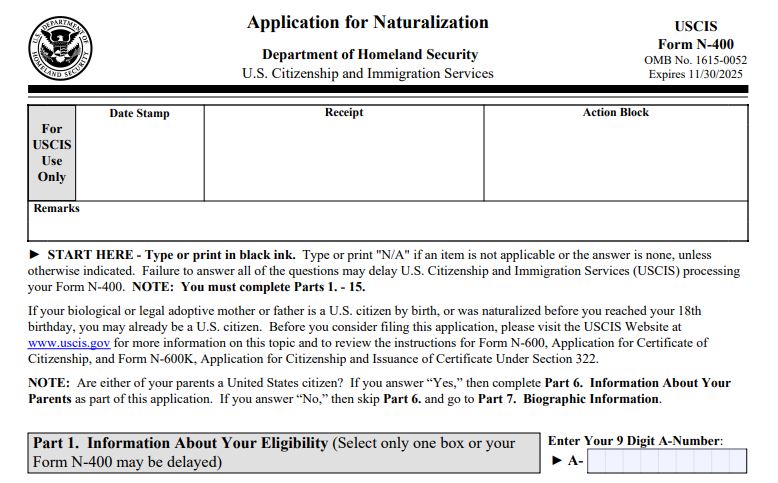
Gather your supporting documents — green card, tax records, travel history, and any relevant legal records — and complete Form N-400 accurately. Errors or omissions are among the most common causes of delays.
File your completed N-400 with USCIS along with the required filing fee and supporting documents. You may file online at uscis.gov or by mail.
Pro tip: USCIS allows you to file up to 90 days before you reach your required residency period, so you don't have to wait until the exact anniversary date.
USCIS will schedule a biometrics appointment. You will provide your fingerprints, photograph, and signature for a background check.
A USCIS officer will review your N-400 application and ask questions about your background. This is also when you take the English and Civics tests (see below). Be prepared to answer questions in English.
You need to pass the naturalization test to obtain your U.S. citizenship. During your naturalization interview, you must answer questions regarding your background and application. Also, you must take the English and civics tests unless you are eligible for a waiver or exemption.
• The English language test has three parts – reading, writing, and speaking. Basic English proficiency is adequate.
• The Civics test will cover basic knowledge of the U.S. government and its history.
If you fail the test, you will have two opportunities to take both tests and to answer questions about your application in English. Should you fail any of these tests during your initial interview, you'll be retested on the section you failed between 60 and 90 days from your interview date.
Important Note: You must inform the USCIS if you change your address after you’ve submitted Form N-400 within 10 days of your move. Visit uscis.gov/addresschange to know how to change your address.
After your interview, USCIS will either approve your application, continue it (pending more information), or deny it. Most applicants receive a decision on the same day as the interview.
If approved, USCIS will notify you of your scheduled Oath of Allegiance ceremony. This can take place on the same day as your interview or at a later scheduled ceremony.
At the ceremony, you will formally swear allegiance to the United States and renounce prior allegiances. Once you take the Oath, you are officially a U.S. citizen and will receive your certificate.
The average processing time for Form N-400 is nine months. It varies depending on your chosen service center or field office. In St. Louis, MO, 80% of cases are complete within 12.5 months. Check case processing times online.
Secure your path forward with a trusted immigration team.
Find Out More About the Citizenship Service

The perks of becoming a citizen of the United States are as follows:
• Get a U.S. passport – You will have the right to obtain a passport and assistance from the U.S. Embassies and Consulates when traveling abroad.
• Obtain federal benefits – Unlike green card holders, who have limited access to government assistance programs, becoming a U.S. citizen will give you full access to Medicare, Social Security, and other federal benefits. You may also obtain federal college assistance programs that are not offered to non-U.S. citizens.
• No green card renewal – Once you become a citizen, you don’t have to renew your green card every 10 years. You will not be required to always bring your green card with you.
• Risk of deportation is significantly reduced – You will enjoy as much right as any American to work and live in the U.S. Even if you are sued, you will be able to remain in the country.
• Petition family members – As a U.S. citizen, you will be able to petition your family into the U.S. These include your parents, children, and siblings.
• Vote and even run for public office – Only citizens of the U.S. can vote. Also, naturalized citizens can run for elected public office.
• Apply for federal jobs, government benefits, and grants – There are jobs that are offered only to U.S. citizens. These include state, local, and federal government positions. Most federal scholarships and grants are also made available only to citizens.
• Take long trips outside the U.S. – You’ll be permitted to travel out of the U.S. for a long time without the risk of losing your citizenship.
Dual citizenship refers to becoming a citizen of two different countries. The U.S. allows dual citizenship or nationality by default. It won’t require you to give up your citizenship in your country of origin.
Remember that your country of origin may not allow you to have dual citizenship. India and China won’t recognize your U.S. citizenship on their soil. In some cases, you can automatically lose your citizenship as soon as you become a U.S. citizen.
Before applying for U.S. citizenship, you must understand the rules about dual citizenship in your country of origin. Only then can you submit Form N-400 to the USCIS to get your U.S. citizenship and ensure that you are still a citizen in your country of origin.
Get step-by-step help to apply. Schedule your call today.
The processing time for Form N-400 averages around 9 months, though it can vary significantly by location. Some USCIS field offices may take up to 12 to 18 months to complete a case. Processing times fluctuate based on application volume, staffing, and your individual circumstances. You can check current processing times at uscis.gov.
Yes — most applicants must first be lawful permanent residents, which means going through the adjustment of status process. Understanding the I-485 processing time helps you plan how far out your citizenship eligibility really is. Typically, you need a green card for 5 years (or 3 years if through marriage), with limited exceptions like military service.
Form N-400 is the Application for Naturalization — a USCIS form you must file to begin the citizenship process. It collects information about your background, residency history, employment, travel outside the U.S., and moral character. Filing this form with the correct supporting documents and fee is the starting point of your naturalization journey.
Both timelines are possible, depending on your situation:
• 3-Year Rule: You may apply after 3 years as a green card holder if you have been married to and living with a U.S. citizen for the entire 3-year period prior to filing.
• 5-Year Rule: Most green card holders must wait 5 years before applying.
• Early Filing Tip: USCIS allows you to file your N-400 up to 90 days before you reach your required residency period, so you don't have to wait until the exact anniversary date.
To qualify for naturalization, you generally must:
• Be at least 18 years old
• Have been a lawful permanent resident for the required period (3 or 5 years)
• Maintain physical presence in the U.S. and continuous residence
• Can write, read, and speak basic English
• Show understanding of U.S. history and government.
• Be a person of good moral character
• Be willing to take the Oath of Allegiance to the United States
If you fail either the English test or the civics test during your initial interview, you will be given a second opportunity to take the failed portion. The retest is typically scheduled 60 to 90 days after your initial interview date. If you fail the retest, your application may be denied, and you would need to refile.
The naturalization process can be time-consuming, challenging, and very complex. Thus, it is a wise choice to get immigration help when applying for U.S. citizenship.
Here at Hacking Immigration Law, LLC, we know the requirements of various citizenship and immigration services. We have assisted hundreds of immigrants to gain their U.S. citizenship, and we can also help you. We are on a mission to help 10,000 immigrants become U.S. citizens by 2030!
Our immigration attorneys will guide you through the naturalization proceedings to improve your chances of approval.